

















Few products transformed the current pharmaceutical market as much as anti-obesity and anti-diabetes drugs delivered via the now-familiar “pen-style injectors,” such as Ozempic and similar products.
What initially seemed like a phenomenon limited to certain patient groups become a booming global market, with demand continuing to rise and pharmaceutical companies working to expand production capacity.
Behind this growth, however, there is more than just medical research and innovative active ingredients. As is often the case, there is a vast amount of less visible industrial work involving processes, automation, and production.
The pharmaceutical industry is one of the most rigorous sectors in terms of quality and control. Every stage must meet high standards: from sterile environments to component handling, from packaging to contamination control. Vacuum is present in these processes much more often than one might imagine.
One of the best-known applications is vacuum freeze-drying, used for certain medications. Through this process, the water contained in the product is removed at low temperatures, preserving its stability and characteristics. Degassing is also used in various processes, removing unwanted gases from liquids or substances that require high purity standards.
But vacuum technology comes into play above all in simpler, everyday operations, such as the handling of vials, bottles, blister packs, and administration systems. In high-speed production lines, it is necessary to move delicate components with precision, avoiding deformation, unwanted contact, and damage.

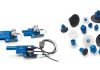
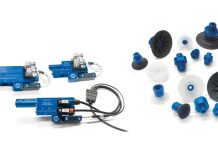
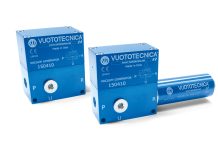
Recently, Vuototecnica developed an application for a client specifically related to the production of so-called “syringe pens”. In this case, vacuum generators and suction cups were used to feed filling and packaging systems.
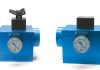
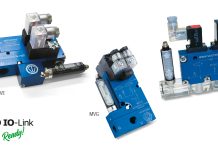
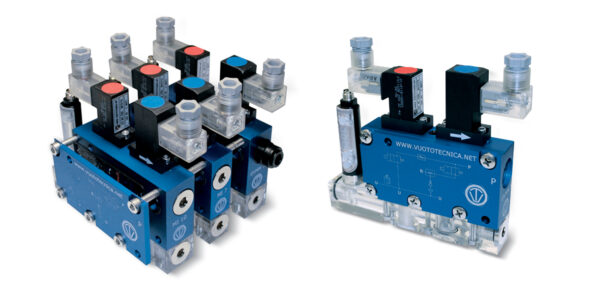
The “pens” are transported vertically inside rotating star wheels with multiple gripping chambers, each equipped with suction cups that must ensure speed, reliability, and precision throughout the entire cycle. To power these systems, the GVMM series of modular multifunction vacuum generators was used, along with rotary vacuum distributors.
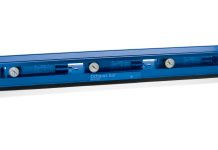
The GVMM series was in fact developed for applications requiring multiple independent vacuum outlets, high suction capacity, and compact dimensions. Thanks to its modular design, it is possible to increase the number of vacuum units without substantial modifications to the system and to manage multiple gripping points independently. Their compactness, light weight, and ability to be installed in various positions make them particularly suitable for automated and robotic systems.
When we think of innovative drugs, we imagine laboratories, researchers, and complex molecules. Rarely do we think of the technologies that enable their production, packaging, and delivery to patients. Yet, behind a small “pen-style syringe” that ends up in a person’s hands, sophisticated vacuum systems may be working silently.
To view the technical data sheets for the GVMM and other Vuototecnica components, you can download the catalogue at www.vuototecnica.net.