















Some graffiti paintings become works of urban art, capable of transforming anonymous walls into spaces for self-expression and even becoming defining features of neighborhoods and cities. Others, however, are not created with artistic intent but are acts of vandalism, scrawled on historic facades, private walls, monuments, public transportation, or surfaces that municipalities and companies must necessarily restore. In these cases, removal must be effective, rapid, and minimally invasive, both to reduce intervention time and to limit disruption and the impact on the surrounding environment.
Among the most widely used solutions is hydro-sandblasting, which combines the action of water with that of abrasive materials to achieve effective cleaning while reducing the dispersion of dust and chemicals into the environment. In these devices, an inert material, such as silica sand or other specific abrasives, is drawn from an external container and directed toward the water jet.
Waterblasting is also used for cleaning facades and monuments, restoring stone or brick surfaces, removing paint, preparing metal surfaces prior to subsequent treatments, and in various industrial restoration and maintenance projects. In many cases, it is an attractive solution because the water helps suppress the dust typically generated by traditional sandblasting, making the process cleaner and more manageable.
At the heart of these systems lies a simple yet versatile physical principle: the Venturi effect. In simple terms, the flow of a fluid through a constricted section creates a vacuum that allows a second material to be drawn in and carried along. In the case of hydro-sandblasting, the material is the abrasive; in other contexts, it can be a liquid, a powder, or a mixture of different substances.
Once the mechanism is understood, one realizes that the same principle is also present in objects we use regularly. The foam nozzles on pressure washers, for example, operate on the same logic. The detergent is drawn in and mixed with water to produce a ready-to-use foam. The materials and the final result may vary, but the operation remains the same.
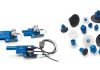
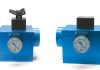
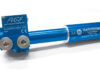
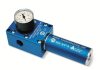
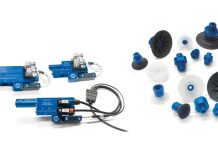
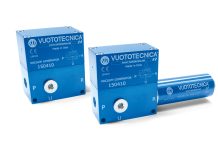
This principle is also utilized in many industrial applications through the Vuototecnica catalogue. The PVR series vacuum generators, for example, use the Venturi principle not only to generate a vacuum but also to draw in powders or liquids from external containers, mixing them with air and then delivering them under pressure to the point of use.

In the past, some customers used Vuototecnica PVRs to blast microspheres of sound-absorbing material against walls under construction covered with mortar. An application far removed from surface cleaning, yet built on the same principle.
This is one of the most fascinating aspects of vacuum technology: seemingly simple mechanisms can find diverse applications and solve problems that, at first glance, would appear to be worlds apart.
To learn more about PVRs and other applications of Vuototecnica products, you can browse the blog sections or visit the website www.vuototecnica.net.