

















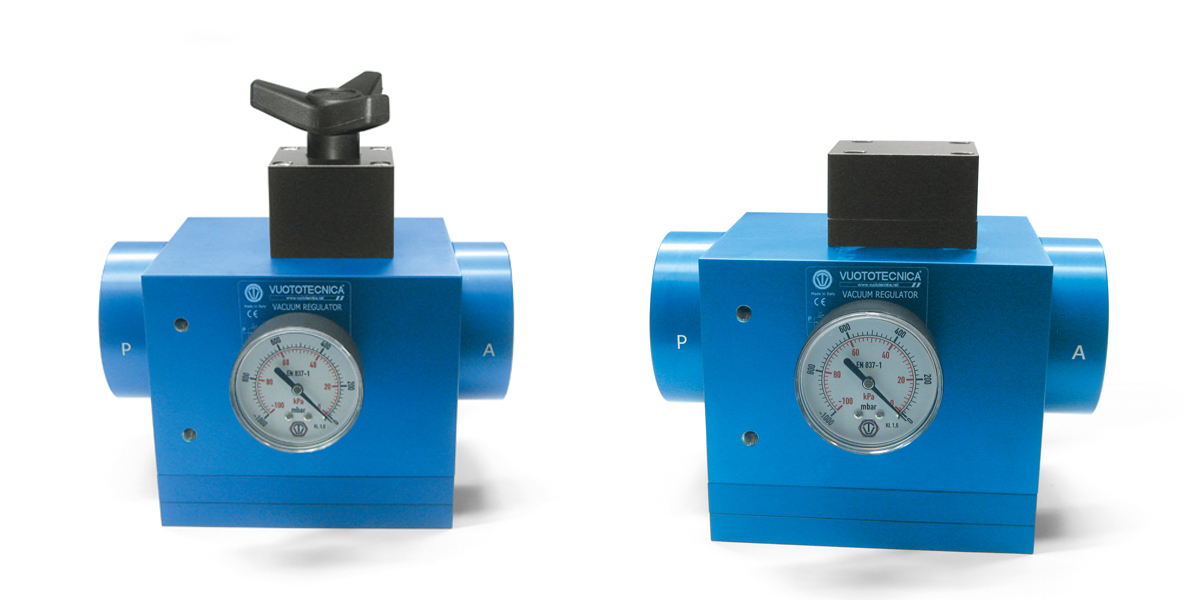
Vacuum system designers know it’s not enough to have a “big” pump: you need to precisely control the vacuum level exactly where it’s needed.
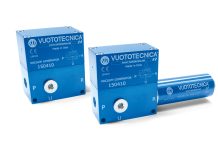
Vacuum reducers are designed specifically to control the vacuum level and maintain it at a constant set value, regardless of fluctuations in the main vacuum supply or the system’s required flow rate.
Unlike control valves, vacuum regulators do not introduce air into the circuit. This allows for multiple vacuum outlets with different vacuum levels to be obtained from a single source.
At Vuototecnica, we have always focused on maximizing the capabilities of vacuum sources such as rotary vane pumps and vacuum generators, adapting the suction sections of the components.
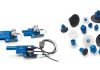
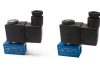
Vacuum solenoid valves with 2” and 3” gas ports had already been introduced to handle high flow rates and large-scale applications. Today, the range is completed with two new families of vacuum reducers, available in 2” and 3” gas sizes, in both manual and pneumatic control versions.
One of the areas where this increase in size was most anticipated is vacuum thermoforming. Consider molds for refrigerator inner shells or for plastic tanks and housings: these are generally large in size, with substantial internal volumes to evacuate, and are served by vacuum pumps with suction ports of precisely 2” or 3” gas.

In these cases, it is not enough to simply “create a high vacuum”; it is necessary to finely control the vacuum level inside the mold to ensure the plastic sheet adheres uniformly, avoiding bubbles, thin spots, and cosmetic defects on the parts.
The new vacuum reducers therefore allow for full utilization of the pumps’ capacity while simultaneously precisely modulating the vacuum level required by the thermoforming cycle.
As mentioned, their advantage over simple control valves is that vacuum control occurs without introducing air into the circuit, which means less energy waste, shorter evacuation times, and the ability to supply multiple outlets with different vacuum levels from a single main line.
In a centralized system, each mold and each zone can have its own vacuum, set according to the shape and thickness of the part, without affecting the rest of the system.
The entire system is thus sized for the various flow rates required, and for those working in vacuum thermoforming as well as in other sectors, this means being able to rely on vacuum control that is more precise, faster, and consistent with the actual dimensions of the systems, without compromising between flow rate and regulation.
To view the technical data sheets for the new vacuum reducers: www.vuototecnica.net.