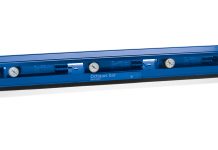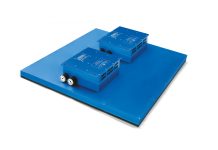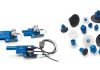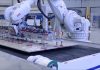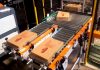
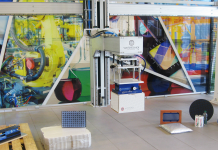





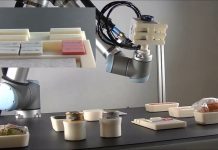









In the following video, a robot equipped with Vuototecnica’s Octopus system performs two related operations: it picks up dry wooden slats from a pallet and assembles another pallet with the still-damp ones, inserting special interlayers.
Note the speed and the ability to move from one phase to another without interrupting the work to adjust or replace the gripping device.
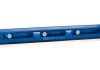
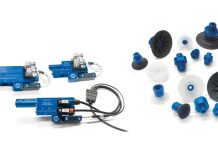
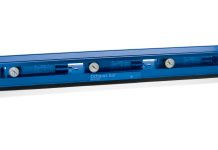
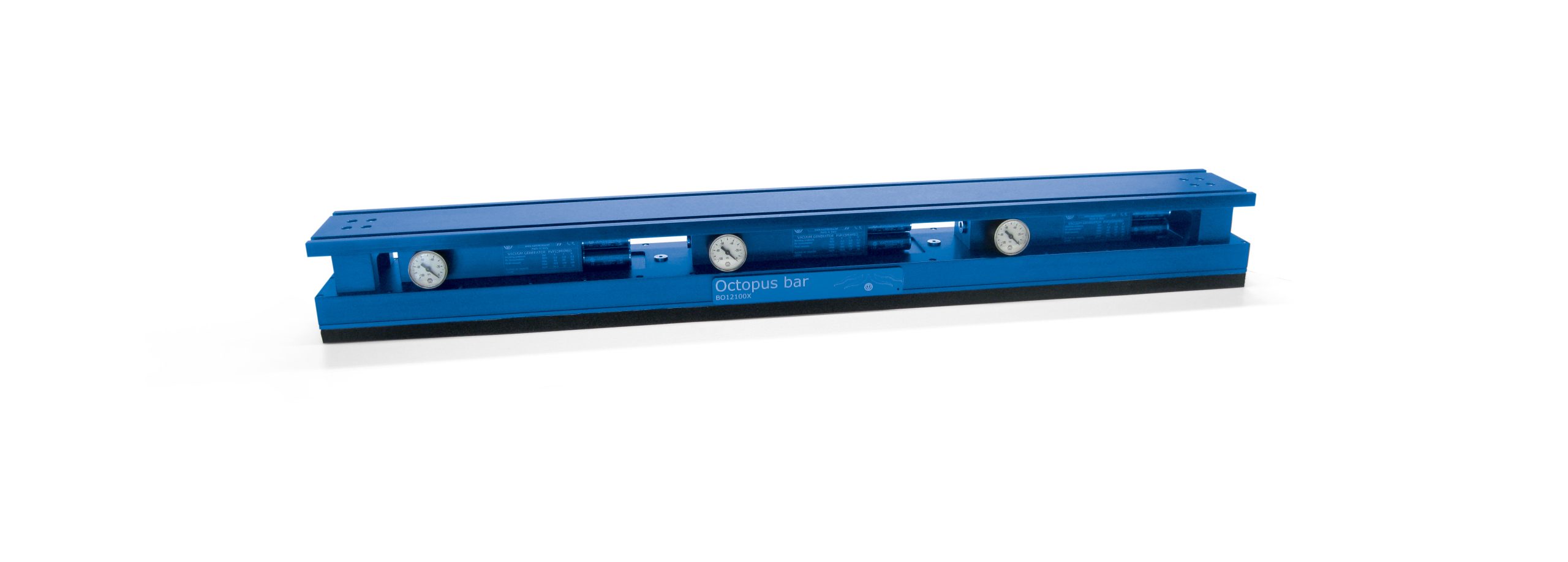
The slats shown in the video range in length from 600 to 2,600 millimeters. This considerable variation makes it impractical to reposition the individual suction cups each time based on the size. The three Octopus bars, on the other hand, distribute the vacuum across the available surface and support even the longest elements during transfer.
Furthermore, wood often has small irregularities or differences in height between one element and another. The sponge-like rubber of the suction pads adapts to these variations and maintains contact with the slats. During lifting, it pulls them toward the surface of the bars, reducing oscillations and flexing.
The most interesting aspect of the application, however, becomes clear when the robot switches materials. The same gripper used for the wooden slats also lifts the interlayers.
Compared to wood, the interlayer is thin and has an irregular surface, thus providing the gripping system with a different contact area. Octopus concentrates the suction in the areas actually covered by the object and maintains the vacuum level necessary for lifting even when the occupied surface area changes.
The robot can thus alternate between the three tasks without replacing the robotic gripper. A single gripper handles the entire cycle and adapts to the varying lengths of the wood and the irregular structure of the separators.
To learn more about the advantages of Octopus vacuum gripping systems: www.vuototecnica.net.