
















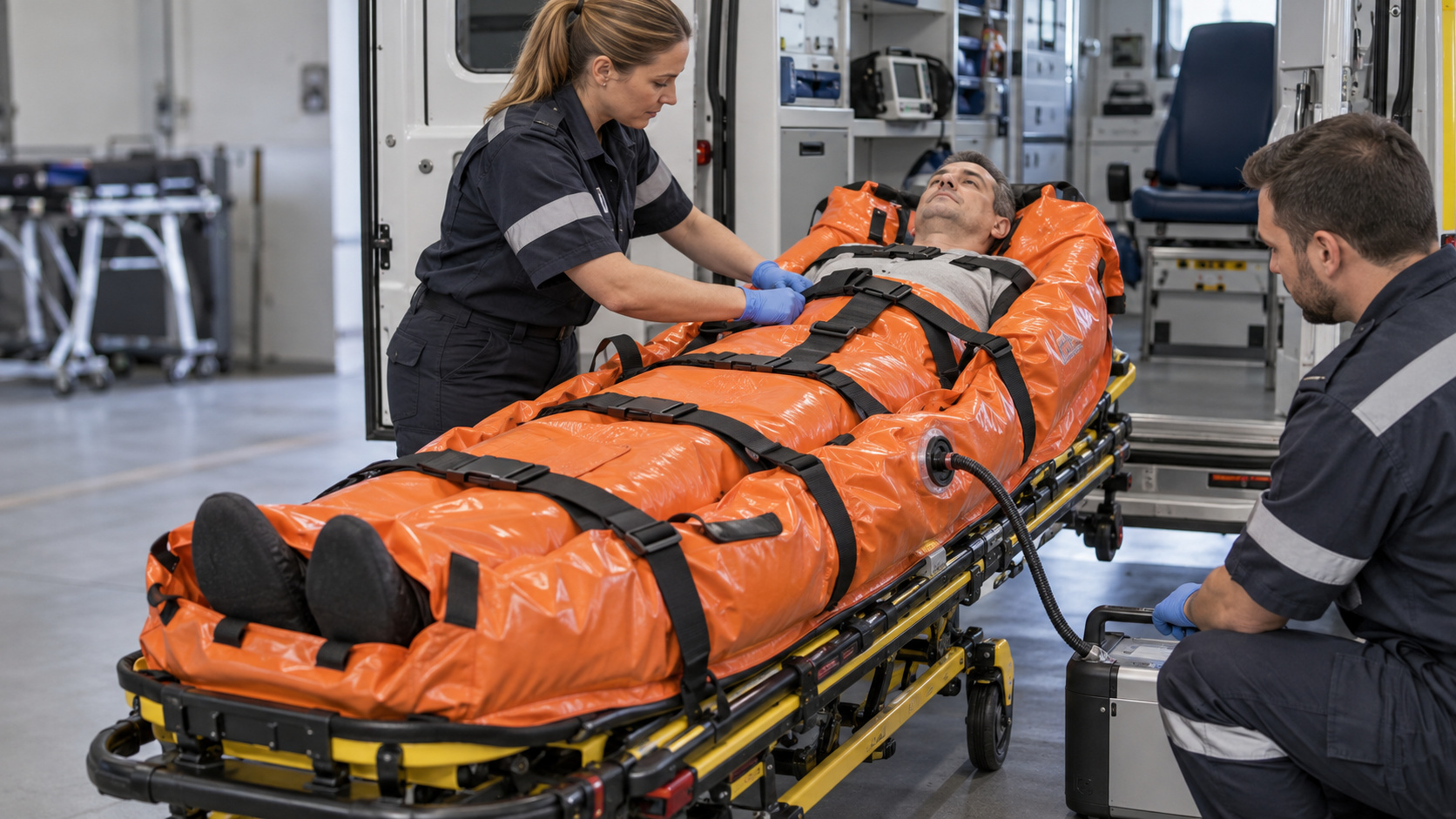
When an ambulance arrives, among the equipment used by first responders is a device that, at first glance, resembles a normal inflatable mattress.
In fact, its operation involves the opposite principle—the use of a vacuum—which is as simple as it is ingenious.
The vacuum mattress is used to immobilize and safely transport certain patients, such as those with suspected spinal injuries. At first, it is soft and malleable, allowing it to be positioned around the body and adapted to the patient’s posture without forcing the body against a rigid surface.
Inside are numerous small plastic beads, which remain free to move as long as air is present in the mattress. After positioning the patient, however, rescuers connect a pump to a special valve and gradually extract the air.
At that point, the transformation occurs: atmospheric pressure compresses the casing, the beads move closer together, and friction prevents them from continuing to flow. In a matter of moments, the mattress loses its flexibility, stiffens, and retains the shape it assumed around the body.
The vacuum thus alters the behavior of the materials contained within the medical device, transforming an initially soft structure into a rigid, contoured support.
The system allows support to be distributed over a wider surface area and helps limit movement during patient transfer. For this reason, vacuum mattresses are used not only in ambulances but also in mountain rescue operations and during air or boat transfers, where it is particularly important to keep the patient stable during handling.
Once use is complete, simply let the air back in: the beads are free to move again, and the mattress is ready to be reshaped.
The same principle is also applied to smaller devices, such as vacuum splints used to immobilize a limb. The dimensions may vary, but the mechanism remains the same: air is extracted, the internal material compacts, and the support takes the shape of the body part it is designed to protect.
In all emergency situations—whether in medical or industrial applications—vacuum technology can provide assistance.
To discover more interesting facts about vacuum technology, keep following the blog or visit the website www.vuototecnica.net.